Ph.D. First-Year Reflection
July 2, 2026
Wow, time really flies. It has already been a year since I left NAVER and arrived at Princeton.
It was truly a huge life transition. My wife and I both left our jobs, moved from Korea to the US, and settled into a completely unfamiliar place (which has now become our home). I also became a student again and took some classes again after ten years since I graduated (it is not a metaphor; I graduated with my master’s in February 2016). And, of course, there are so many things that cannot be written in just a few sentences.
As my first academic year comes to a close, I would like to take a moment to reflect on my first year as a Ph.D. student.
1. Moving to the US
This means far more than a simple change of location. It was the biggest transition in my family’s life.
My wife and I both left our jobs at NAVER, where she had worked for five years, and I had worked for seven and a half years. Before leaving Korea, there were a lot of things to take care of: handling essential paperwork, packing our belongings, throwing out or selling large items, …
I first arrived in Princeton at midnight on July 1st, and later went back to Korea in late August. After bringing the rest of our belongings from Korea, we arrived in Princeton again at midnight on August 27th, which is also our wedding anniversary lol.
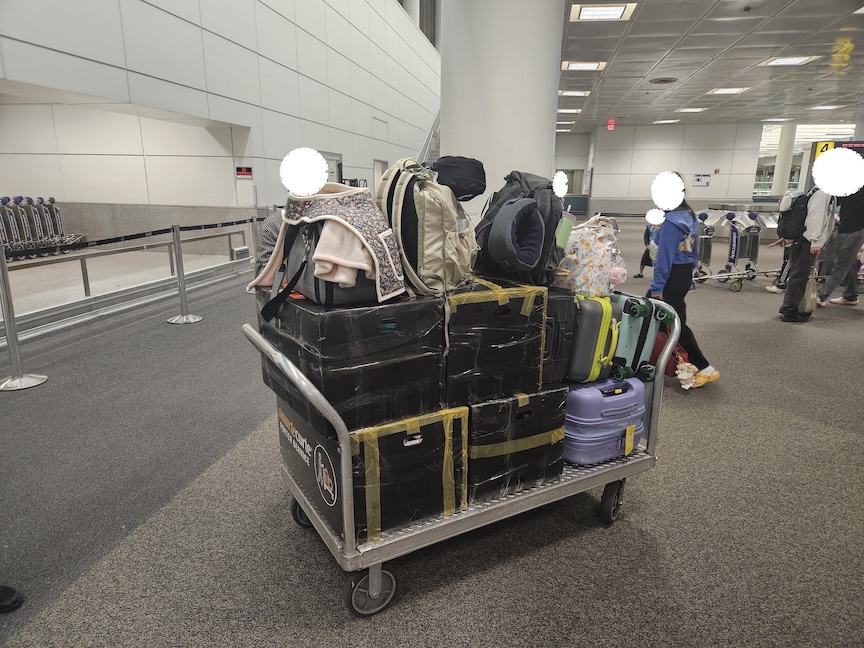
Our belongings from Korea. Moving them all the way here was not easy.
One of the biggest tasks was bringing our cat with us (in the picture, she is in the soft gray carrier). It was super exhausting. By the way, she is doing very well now, and you can see her in my papers haha (See my ProLIP paper figure 2)
After arriving in Princeton, it also took us some time to adjust to our new environment. Things have been getting better, but it is still not easy.
One thing that has made everything harder for us is the language barrier.
2. English
To be honest, I had never thought that my English was particularly bad. I always thought that it was decent, perhaps even quite fluent. I had spent several years collaborating with non-Korean-speaking colleagues in English [C5, C14, C16, J1, C11, WO1].
However, the language barrier is still there. After moving here, I realized that I had very little experience working or casually talking with people who use English as their first language.
Also, I realized that while my English is usually functional enough to get my point across, I often use incorrect or unnatural expressions (especially in terms of grammar). I found that this phenomenon is also known as interlanguage fossilization; according to the wiki page, I feel like I’m somewhere around the “acceptance” stage.
Luckily, I had plenty of chances to practice my English. For example, right after coming to Princeton, I served as an instructor of AI4All, a program for high school students. I gave several teaching sessions and helped with their summer projects. I also took a discussion-based course during my first semester; it was never easy, but it was really helpful. Of course, English was also everywhere in my daily life and research collaborations.
To improve even a little, I have been trying a few small things. For example, every morning, I write down random sentences in English for five to ten minutes; they are mostly about my feelings, or sometimes about things I need to do that day. This is inspired by morning pages, but I don’t use it to organize my to-do list, or schedule (I have my own bullet journal system, so after finishing morning pages, I spend another five minutes writing). It is mostly about expressing my thoughts and feelings in English. After writing this short text, I use an AI agent to revise it and keep track of my mistakes.
Okay, I think that it is now natural to introduce another topic: the AI agents.
3. AI Agents
Everyone would probably agree that AI agents are a game changer. It is very interesting because I first heard about “AI agents” during NeurIPS 2024. At that time, many people were anticipating that 2025 would be the year of AI agents. I never believed it. To be honest, I didn’t think that AI agents would actually be much more useful or powerful than just an (M)LLM.
Okay, I was completely wrong. AI agents have had a much greater impact than I originally anticipated. Maybe we are facing a new turning point. We can no longer go back to a time before AI agents.
My friends in industry tend to focus on the coding ability of AI agents and how they might replace human software engineers. If I were still in industry, I would probably focus on their human-level capability as well. Interestingly, however, I’m now a student and this has given me a different perspective: I can see more how AI agents are changing for junior researchers and students.
I can see two aspects. The bright side: research productivity has improved dramatically. I feel this myself as well. For example, AI agents helped me move much faster when implementing the initial prototype for my CoMet paper. It was my first time actually building something on top of multimodal large language models, and AI agents were super helpful for rapid prototyping.
I also actively use AI agents in my daily life. As I mentioned earlier, I’m using them to improve my language skills (e.g., by feeding my English texts to an agent and letting it organize my frequent mistakes). I even also use them to organize my running sessions. I firmly believe that this is a game changer. With AI agents, we can become much more productive than before.
There is also a dark side. I often feel that I’m no longer thinking as deeply as I used to. Of course, for many things, we don’t need to put in too much effort ourselves: comparing used cars, comparing insurance plans, or planning exercise sessions. We can save our time and effort if we get help from someone else or from good enough AI agents.
However, there are things that we need to focus on and think through carefully and deeply on our own: finding a research question, figuring out how to solve a very difficult problem, structuring our own research presentation or paper, or identifying the main research point of a project. Whenever I use AI agents for my own tasks, I often feel like I’m losing opportunities to grow.
I mean, they are definitely helpful and make me more productive. However, they can make it easier for me to avoid the hard part of thinking. It is too easy and convenient to get an answer to a difficult problem. Using AI agents to solve the problem in front of me may help me move forward in the short term, but in the long run, it can weaken my ability to solve difficult problems by myself. I feel like we may be losing valuable opportunities to struggle, learn, and grow.
I have no great answer yet, but I think we are facing a new normal. We need to figure out how to use AI tools and agents wisely to educate students and train junior researchers.
4. Research
Okay, let’s talk about a more PhD-ish topic: my research! During my first year, I authored two first-author papers:
- Multiplicity is an Inevitable and Inherent Challenge in Multimodal Learning, Sanghyuk Chun, Olga Russakovsky, ICML 2026 Position
- CoMet: Context and Multiplicity Decomposition for Multimodal Uncertainty Estimation. Sanghyuk Chun, et al., arxiv preprint
I also co-authored a few more projects. Fingers crossed for all the submissions!
Through doing my own research, I am gradually beginning to see (however faintly) what I am trying to solve. I’ve always struggled to define my own research theme and agenda, but I think it has been getting clearer. I probably need to write two or three more relevant papers before I can fully solidify it. We will see.
It has also been great to collaborate on topics that were new to me. For example, I recently co-authored a paper about fast-weights, which won the best paper award at ICLR Workshop on Test-Time Updates (TTU). I also had a chance to learn about world models. These experiences have helped me expand my research interests and broaden my perspective.
Anyways, it felt quite strange to juggle all of these things at the same time: doing a course project and assignments, writing meta-reviews, writing my first-author paper, mentoring collaborators on projects that had started during my time at NAVER.
5. Life Things
I ran two half marathon races during my first year! Running has also become an important part of my routine. It was one of the few things that helped me stay grounded during this busy year.
Last but not least, there is life as a married PhD student. I do not think I can summarize it better than this:
Life of Married PhD pic.twitter.com/JdI1352H7L
— Scholarship for PhD (@ScholarshipfPhd) April 1, 2026